 FluentPath
Dental Spanish for dentists and dental hygienists
Talk your patient through the chair in Spanish.
Real chairside conversations with an AI tutor, every day: seat the patient, warn before you numb, check for pain. It meets you at whatever level your Spanish is now.

Free 7-day trial. No credit card required.5.0 on the App Store
See how it worksWhat FluentPath does differently
For dentists and hygienists serious about actually using the language: speaking-first practice, every day, focused on the chairside conversations you really have, from beginner to advanced.
Speaking from lesson one
Hold the microphone and talk. The AI tutor talks back, corrects, and keeps you in the conversation when you stall.
Conversations shaped like a chairside visit
Practice the flow of an appointment: seating and orienting the patient, warning before numbing, checking in during the procedure, and post-op instructions.
A tutor with patience you can't burn through
Stumble through the same instruction twenty times without a patient in the chair. Won't switch to English on you. Tracks what you know and pulls you forward.
Spaced repetition that actually retains
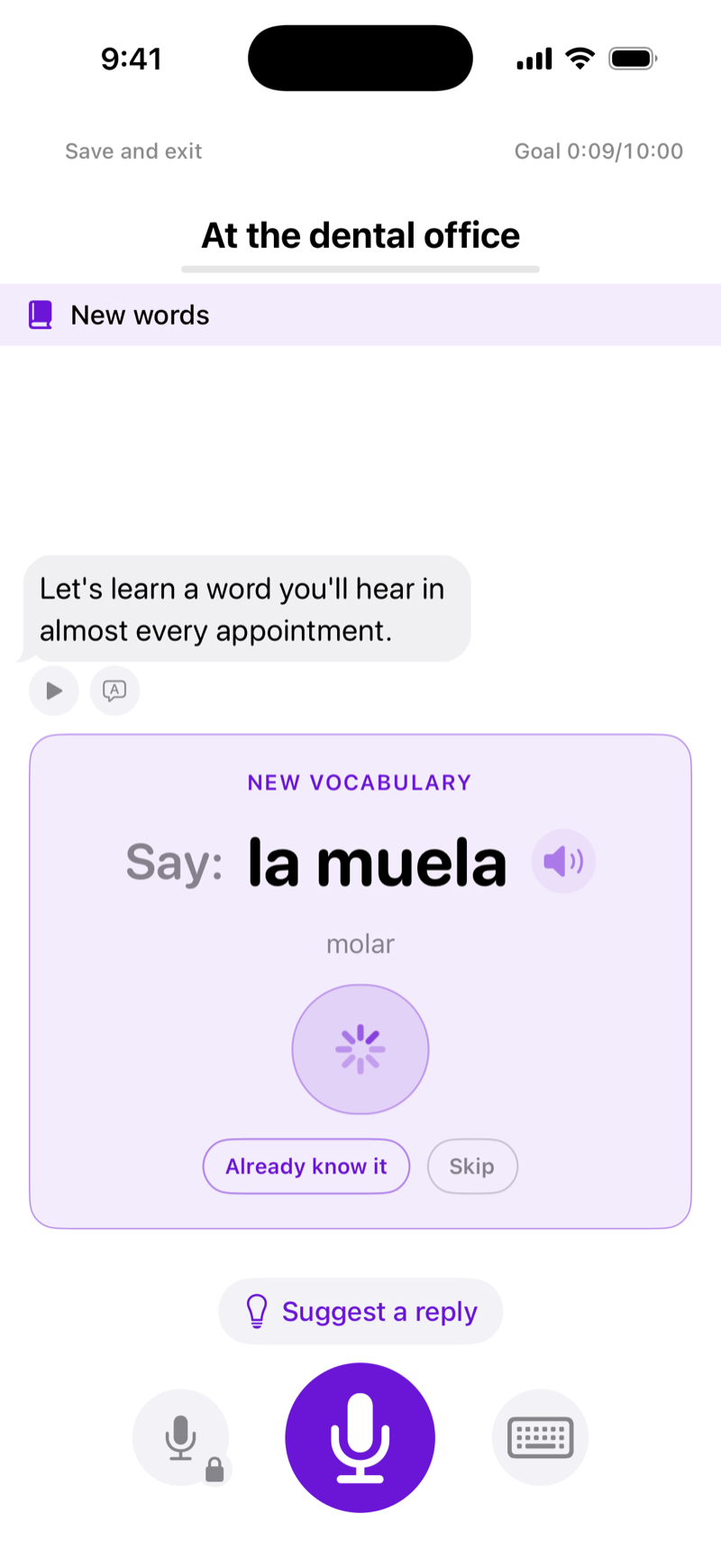
Tooth, pain, and procedure vocabulary you've used in conversation comes back at intervals tuned to memory science, so the words you need chairside stick.
Example practice scenarios
Seating and orienting
Have a seat, lean back, open wide, turn toward me, raise your hand if you need a break. The chairside choreography, in Spanish.
Numbing and comfort
I'm going to numb this area, you'll feel a small pinch, tell me if it still hurts. Warning before you work and checking for pain as you go.
During a cleaning or filling
Bite down, rinse and spit, you'll hear a noise, almost done. The running commentary that keeps a nervous patient with you.
Post-op and home care
Don't eat for a couple of hours, avoid chewing on that side, floss gently here, come back if the swelling doesn't go down. Aftercare they'll actually follow.
Or describe a scenario you want to rehearse: your procedures, your patient population, the appointments you have most, and the app builds it.
New to this? Start with our list of Spanish phrases for dentists.
How it builds
Not a script. A language.
Three moments from the same first year. Nothing here was memorised, and no two conversations were the same.
Week one
Seating the patient
Tutor Patient
Buenos días.
You Dentist
Pásele y siéntese, por favor.
Come in and have a seat, please.
Three months later
Before the anesthetic
Tutor Patient
¿Me va a doler?
You Dentist
Le voy a poner anestesia. Solo va a sentir un piquete.
I'm going to give you anesthetic. You'll only feel a small prick.
A year later
A child who won't open up
Tutor Child
¡No quiero!
You Dentist
No te voy a lastimar. Vamos a contar hasta tres.
I'm not going to hurt you. Let's count to three.
Practice a scene like this
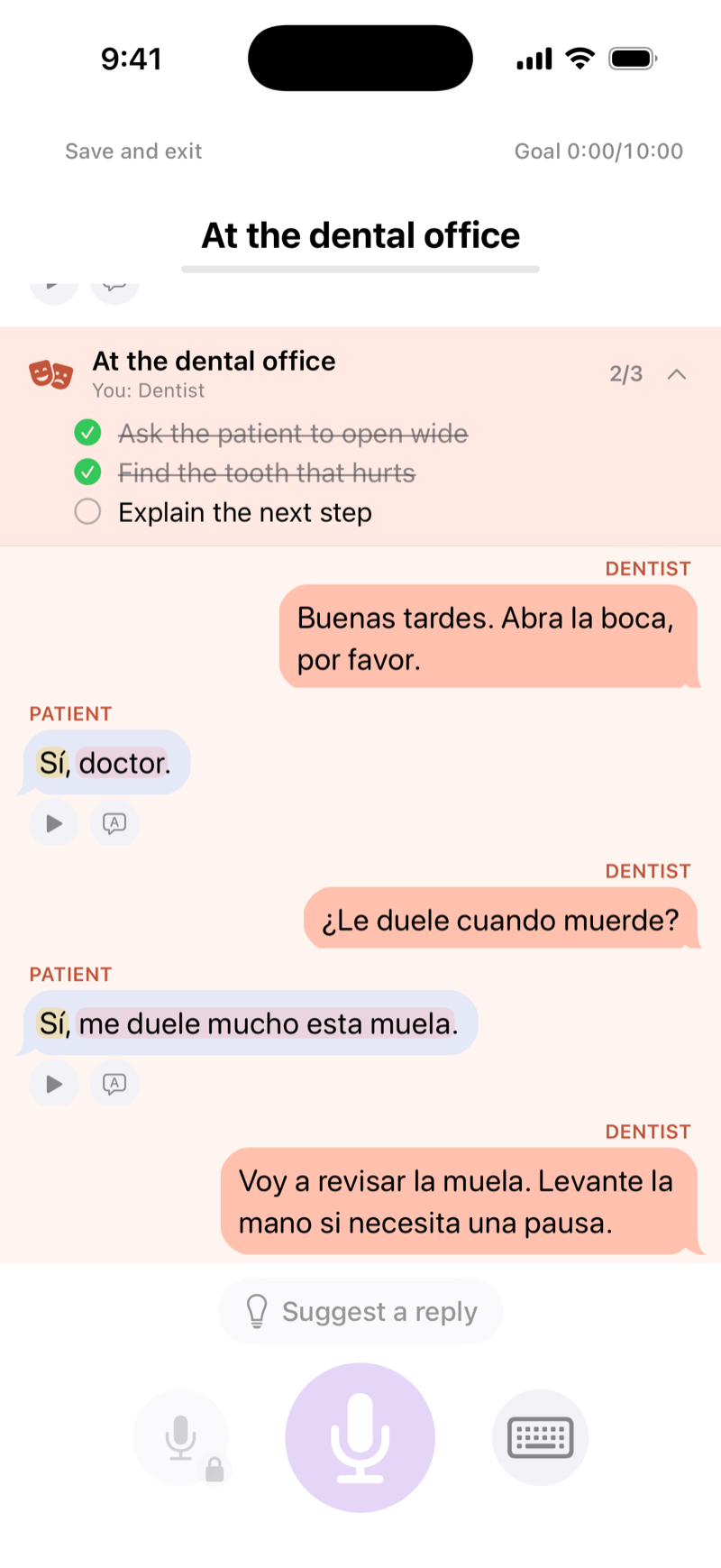
From a beginner-level roleplay. You speak your lines out loud; the AI answers as your patient.
You
Abra la boca, por favor.
Open wide, please.
Patient
¿Me va a doler?
Is it going to hurt?
You
No se preocupe. Levante la mano si necesita una pausa.
Don't worry. Raise your hand if you need a break.
Patient
Está bien.
Okay.
You
¿Le duele cuando muerde?
Does it hurt when you bite down?
Patient
Sí, me duele esta muela.
Yes, this molar hurts.
What it looks like
Real screens from the app.
Where you can speak yourself, and where you shouldn't
A patient is already tense in the chair. You want to tell them the pinch is coming and that they can stop you any time, but you can't, so you mime it and start. They flinch at the needle they didn't see coming, and the trust you were building is gone. That running chairside talk is most of what makes an appointment go well, and it's the part you can do yourself, if you can speak even a little.
What FluentPath is and isn't for
FluentPath helps you build the everyday Spanish you'll use chairside: seating, comfort, warning before numbing, checking for pain, post-op and home care. It is not a substitute for a certified medical interpreter. For consent to a procedure, complex treatment plans, or anything where mis-translation creates clinical or legal risk, use a certified interpreter.
Much of this Spanish carries across the rest of medicine. Medical history and the questions that open a visit are the Spanish for doctors page, and the comfort and reassurance language is shared with the Spanish for nurses app.
The head start you'll have after a few months
Roughly fifteen minutes a day for three months. Comfort-level Spanish for chairside care, not certified medical interpretation.
- Seat and orient a patient in the chair in Spanish without freezing up.
- Warn before you numb and check for pain during a procedure, in the moment.
- Give simple post-op and oral-hygiene instructions a patient will actually follow.
- Recognize a few hundred of the most common tooth, pain, and procedure words by ear.
- Keep a nervous patient calm with the running "almost done, you're doing great" chairside talk.
- Know clearly where the line is, and reach for a certified interpreter on consent and treatment plans every time.
Nobody becomes fluent in a few months of phone-app practice, including with us. The goal is comfort-level Spanish for the chairside moments that make an appointment go well, so a certified interpreter is reserved for consent and complex plans and your patients aren't sitting through a procedure they were never talked through.
Medical Spanish for your role
Same speaking-first app, tuned to the conversations you actually have. Practice the Spanish your role runs on.
Or start with the full medical Spanish app overview to see how FluentPath works across healthcare.
Common questions
Direct answers. If something's unclear, the contact form is in the footer.
Is FluentPath a substitute for a certified medical interpreter?
Do I need to already speak Spanish, or can I start as a beginner?
How much does it cost?
What languages does it support?
Does it cover dental terms and procedures?
What devices does it work on?
How much practice per day?
Can my whole practice share one subscription?
Start with the conversation you need most.
You'll be speaking in your first lesson, whatever your level.
 Scan to install on iPhone
Free 7-day trial. No credit card required.5.0 on the App Store