 FluentPath
Medical Spanish for doctors and physicians
Take the history in Spanish yourself.
Real exam-room conversations with an AI tutor, every day: open the visit, take the history, explain the plan. It meets you at whatever level your Spanish is now.

Free 7-day trial. No credit card required.5.0 on the App Store
See how it worksWhat FluentPath does differently
For physicians serious about actually using the language: speaking-first practice, every day, focused on the visit conversations you really have, from beginner to advanced.
Speaking from lesson one
Hold the microphone and talk. The AI tutor talks back, corrects, and keeps you in the conversation when you stall.
Conversations shaped like a visit
Practice the flow you run all day: chief complaint, history of present illness, directing the exam, a plain-language plan, and return precautions.
A tutor with patience you can't burn through
Stumble through the same question twenty times without a patient waiting. Won't switch to English on you. Tracks what you know and pulls you forward.
Spaced repetition that actually retains
Symptom, body-part, and instruction vocabulary you've used in conversation comes back at intervals tuned to memory science, so the words you reach for in the room stick.
Example practice scenarios
Chief complaint and history
Where does it hurt, when did it start, what makes it better or worse, have you had this before. The opening minutes of a visit, in Spanish.
Directing the physical exam
Take a deep breath, follow my finger, tell me if this is tender, sit up for me. The short imperatives an exam runs on.
Explaining a plan in plain terms
What the test is for, what you think is going on at a simple level, what happens next, and when to come back.
Medication and return precautions
How to take it, how often, what to watch for, and the symptoms that mean come back now. The safety-net talk before they leave.
Or describe a scenario you want to rehearse: your specialty, your patient population, the visits you have most, and the app builds it.
New to this? Start with our list of Spanish phrases for doctors.
How it builds
Not a script. A language.
Three moments from the same first year. Nothing here was memorised, and no two conversations were the same.
Week one
Opening the visit
Tutor Patient
Buenas tardes, doctor.
You Doctor
Buenas tardes. ¿Qué lo trae hoy?
Good afternoon. What brings you in today?
Three months later
Explaining a test
Tutor Patient
¿Para qué es el estudio?
You Doctor
Es para revisar cómo está funcionando el riñón.
It's to check how your kidney is working.
A year later
A patient afraid of surgery
Tutor Patient
Tengo miedo de la operación.
You Doctor
Es normal tener miedo. Dígame qué es lo que más le preocupa.
It's normal to be afraid. Tell me what worries you most.
Practice a scene like this
From a beginner-level roleplay. You speak your lines out loud; the AI answers as your patient.
You
Buenas tardes. Dígame, ¿qué le pasa?
Good afternoon. Tell me, what's going on?
Patient
Tengo mucha tos.
I have a bad cough.
You
¿Desde cuándo tiene la tos?
How long have you had the cough?
Patient
Desde hace una semana.
For a week now.
You
¿Toma algún medicamento?
Do you take any medications?
Patient
Solo para la presión.
Just for my blood pressure.
What it looks like
Real screens from the app.
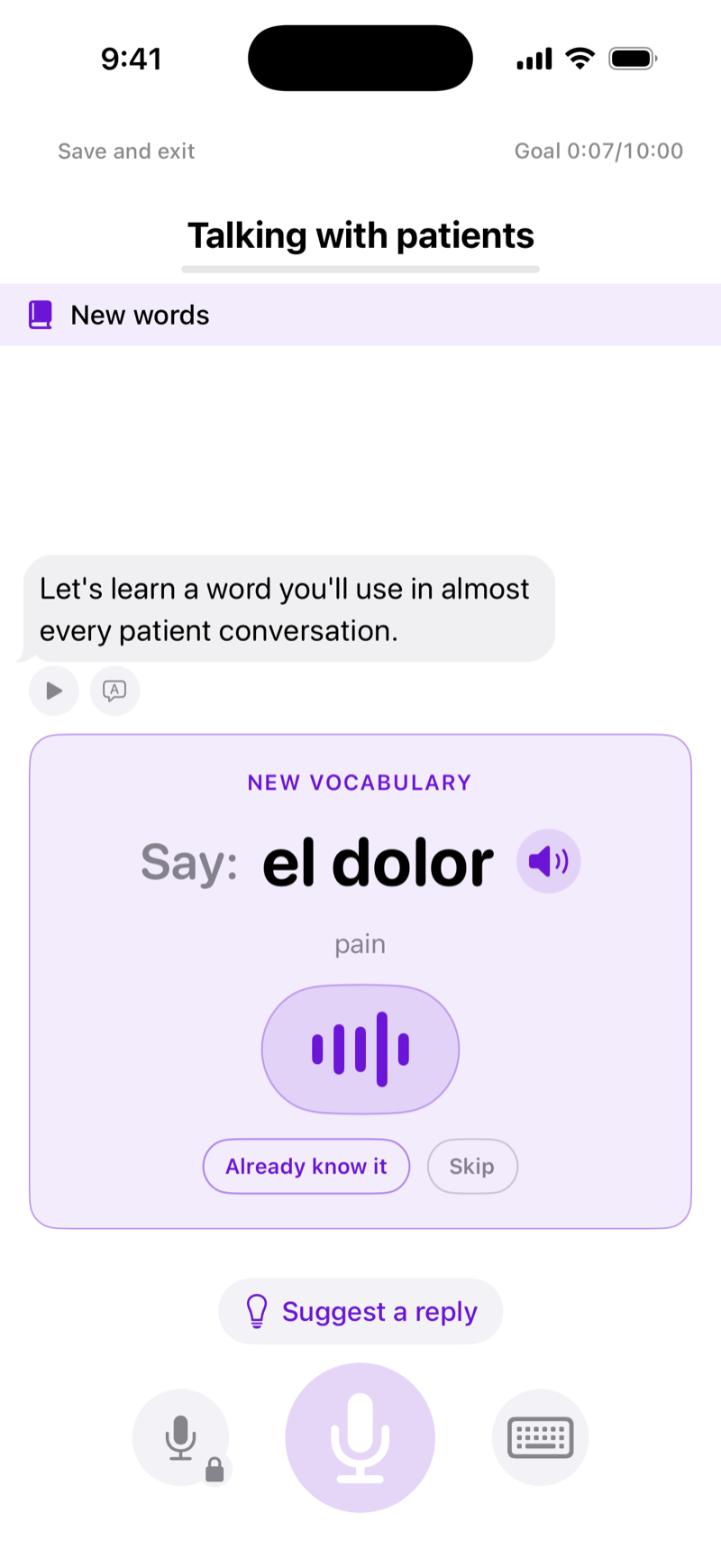
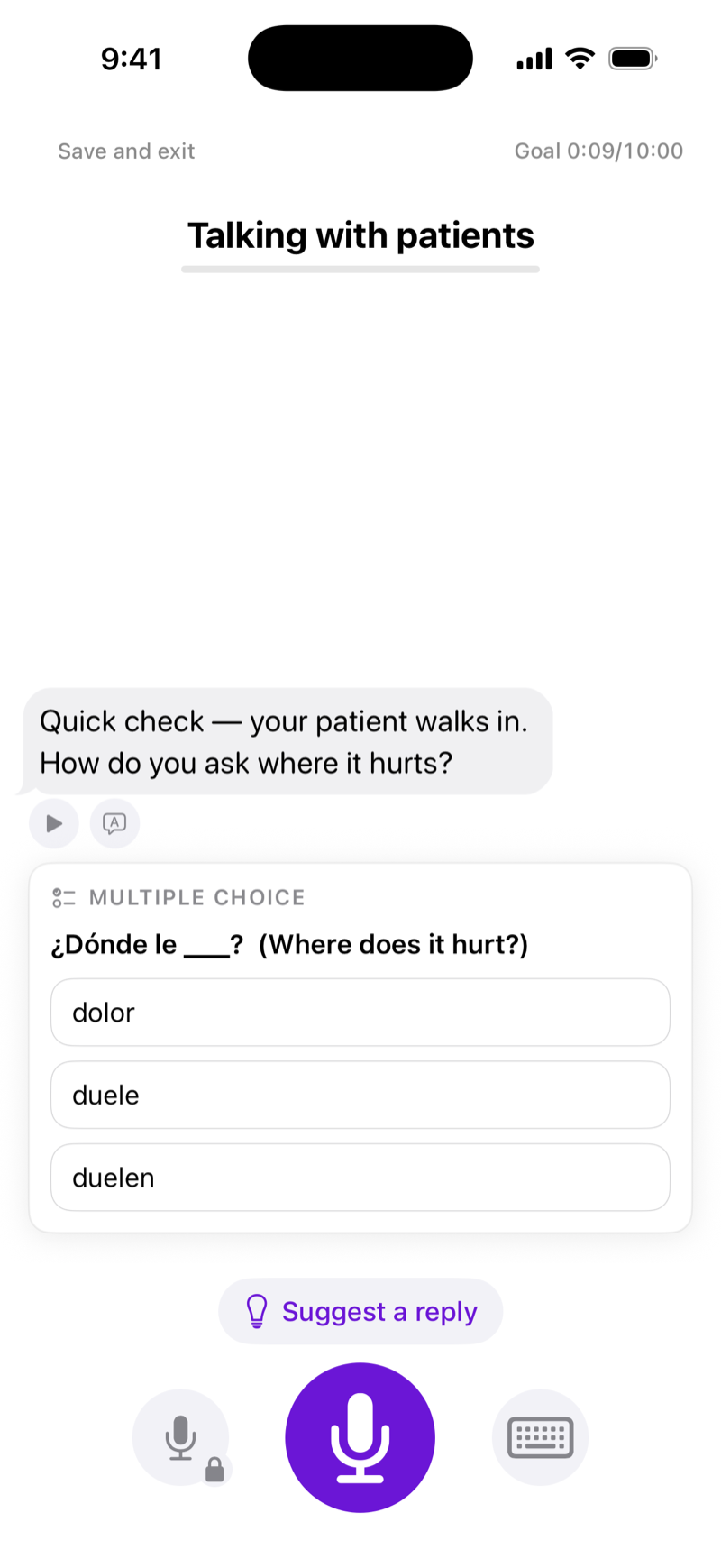
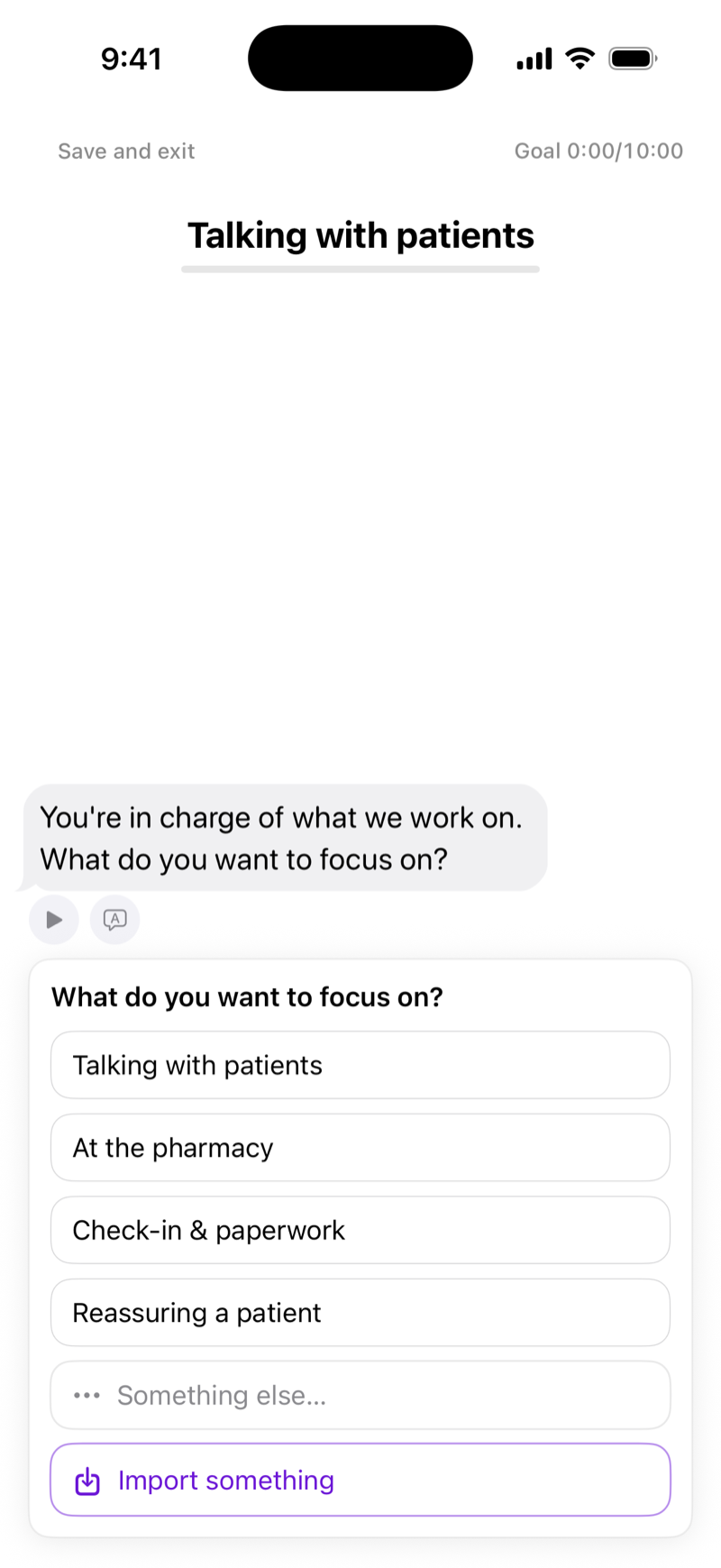
Where you can speak yourself, and where you shouldn't
A patient describes their symptoms and you catch most of it. You want the two follow-up questions that would sharpen the picture, but the interpreter line is on a 10-minute hold and the room is booked back to back. So you gesture, simplify, and lose the detail a real history would have surfaced. The line exists for consent and diagnosis; the routine texture of a visit is the part you can do yourself, if you can speak even a little.
What FluentPath is and isn't for
FluentPath helps you build the everyday Spanish you'll use in the exam room: history questions, exam-room directions, simple explanations, return precautions. It is not a substitute for a certified medical interpreter. For informed consent, delivering a diagnosis, complex care plans, or anything where mis-translation creates clinical or legal risk, use the language line.
Nobody in the building works alone on this. The nurse who takes your orders is working from the Spanish for nurses app, and if your patient arrived by ambulance, the first history was taken in Spanish for paramedics on scene.
The head start you'll have after a few months
Roughly fifteen minutes a day for three months. Comfort-level Spanish for the routine of a visit, not certified medical interpretation.
- Open a visit and take a basic chief complaint and history in Spanish without freezing up.
- Give routine exam-room directions (breathe, point to the pain, sit up, follow my finger) without a translator.
- Explain simple next steps, what a test is for, and return precautions at a comfort level.
- Recognize a few hundred of the most common symptom, body-part, and medication words by ear.
- Ask the one or two follow-up questions that would otherwise wait on a 10-minute hold.
- Know clearly where the line is, and reach for the interpreter on consent and diagnosis every time.
Nobody becomes fluent in a few months of phone-app practice, including with us. The goal is comfort-level Spanish for the routine parts of a visit, so the interpreter line is reserved for the moments that actually need it and your patients aren't getting a thinner version of you the rest of the time.
Medical Spanish for your role
Same speaking-first app, tuned to the conversations you actually have. Practice the Spanish your role runs on.
Or start with the full medical Spanish app overview to see how FluentPath works across healthcare.
Spanish for nurses
Bedside Spanish for vitals, pain checks, the med pass, and comfort rounds.
Spanish for dentists & hygienists
Chairside Spanish from seating the patient to post-op care.
Spanish for paramedics and EMTs
Prehospital Spanish for the chief complaint, focused history, and the back of the rig.
Common questions
Direct answers. If something's unclear, the contact form is in the footer.
Is FluentPath a substitute for a certified medical interpreter?
Do I need to already speak Spanish, or can I start as a beginner?
How much does it cost?
What languages does it support?
Will it cover my specialty?
What devices does it work on?
How much practice per day?
Can my whole practice share one subscription?
Start with the conversation you need most.
You'll be speaking in your first lesson, whatever your level.
 Scan to install on iPhone
Free 7-day trial. No credit card required.5.0 on the App Store