 FluentPath
Medical Spanish for nurses
The Spanish for nurses app where you do the talking.
Talk your patients through the shift: real bedside conversations with an AI tutor, every day, covering vitals, pain checks, and the med pass. It meets you at whatever level your Spanish is now.

Free 7-day trial. No credit card required.5.0 on the App Store
See how it worksWhat FluentPath does differently
For nurses serious about actually using the language: speaking-first practice, every day, focused on the bedside conversations you really have, from beginner to advanced.
Speaking from lesson one
Hold the microphone and talk. The AI tutor talks back, corrects, and keeps you in the conversation when you stall.
Conversations shaped like a shift
Practice the flow you run all day: assessment and vitals, pain checks, the medication pass, comfort rounds, and the call-light reassurance in between.
A tutor with patience you can't burn through
Stumble through the same question twenty times with nobody waiting on the call light. Won't switch to English on you. Tracks what you know and pulls you forward.
Spaced repetition that actually retains
Symptom, medication, and comfort vocabulary you've used in conversation comes back at intervals tuned to memory science, so the words you reach for at the bedside stick.
Example practice scenarios
Assessment and vitals
I'm going to check your blood pressure, take a deep breath for me, let me listen to your heart. The head-to-toe check-in, in Spanish.
Pain and comfort check
Rate your pain from zero to ten, is it sharp or dull, are you comfortable, do you need to be repositioned. The questions you ask every round.
Passing medications
This one is for your pain, take it with water, this may make you drowsy, tell me if you feel any different. The med pass, explained.
Call light and orientation
Press this button if you need me, I'll be back to check on you, raise your hand if the pain gets worse. Orienting a patient and answering the light.
Or describe a scenario you want to rehearse: your unit, your patient population, the shifts you work most, and the app builds it.
New to this? Start with our list of Spanish phrases for nurses.
How it builds
Not a script. A language.
Three moments from the same first year. Nothing here was memorised, and no two conversations were the same.
Week one
Starting the shift
Tutor Patient
Buenos días.
You Nurse
Buenos días. ¿Cómo durmió?
Good morning. How did you sleep?
Three months later
Before a blood draw
Tutor Patient
¿Me va a sacar sangre?
You Nurse
Voy a sacarle una muestra. Va a sentir un piquete.
I'm going to take a sample. You'll feel a small prick.
A year later
A patient refusing her medication
Tutor Patient
No quiero tomar esa pastilla.
You Nurse
Entiendo. Dígame qué le preocupa y lo vemos juntas.
I understand. Tell me what worries you and we'll work through it together.
Practice a scene like this
From a beginner-level roleplay. You speak your lines out loud; the AI answers as your patient.
You
¿Cómo se siente? ¿Tiene dolor?
How are you feeling? Are you in pain?
Patient
Sí, me duele la espalda.
Yes, my back hurts.
You
Del cero al diez, ¿cuánto le duele?
Zero to ten, how bad is the pain?
Patient
Un siete.
A seven.
You
Le voy a tomar la presión. Presione este botón si me necesita.
I'm going to take your blood pressure. Press this button if you need me.
Patient
Está bien, gracias.
Okay, thank you.
What it looks like
Real screens from the app.
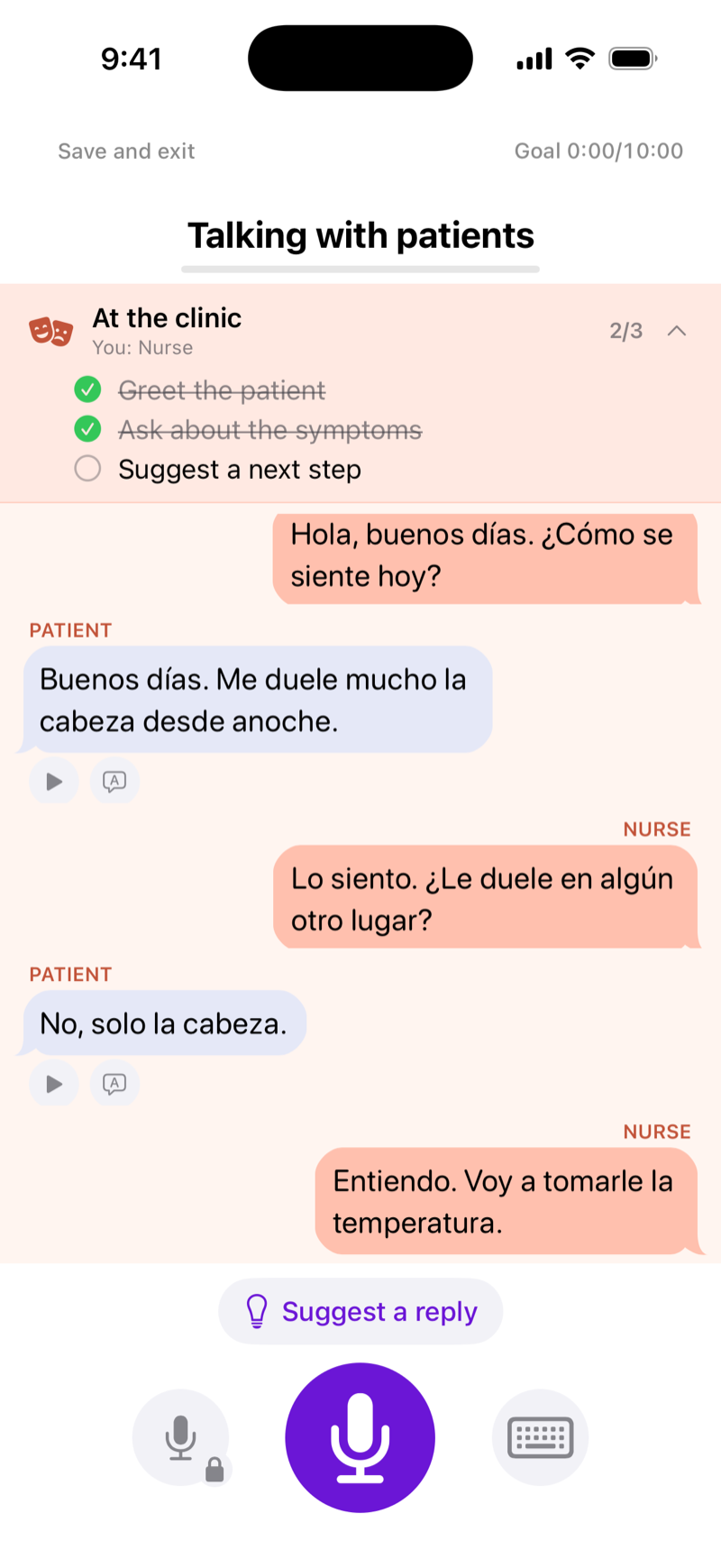
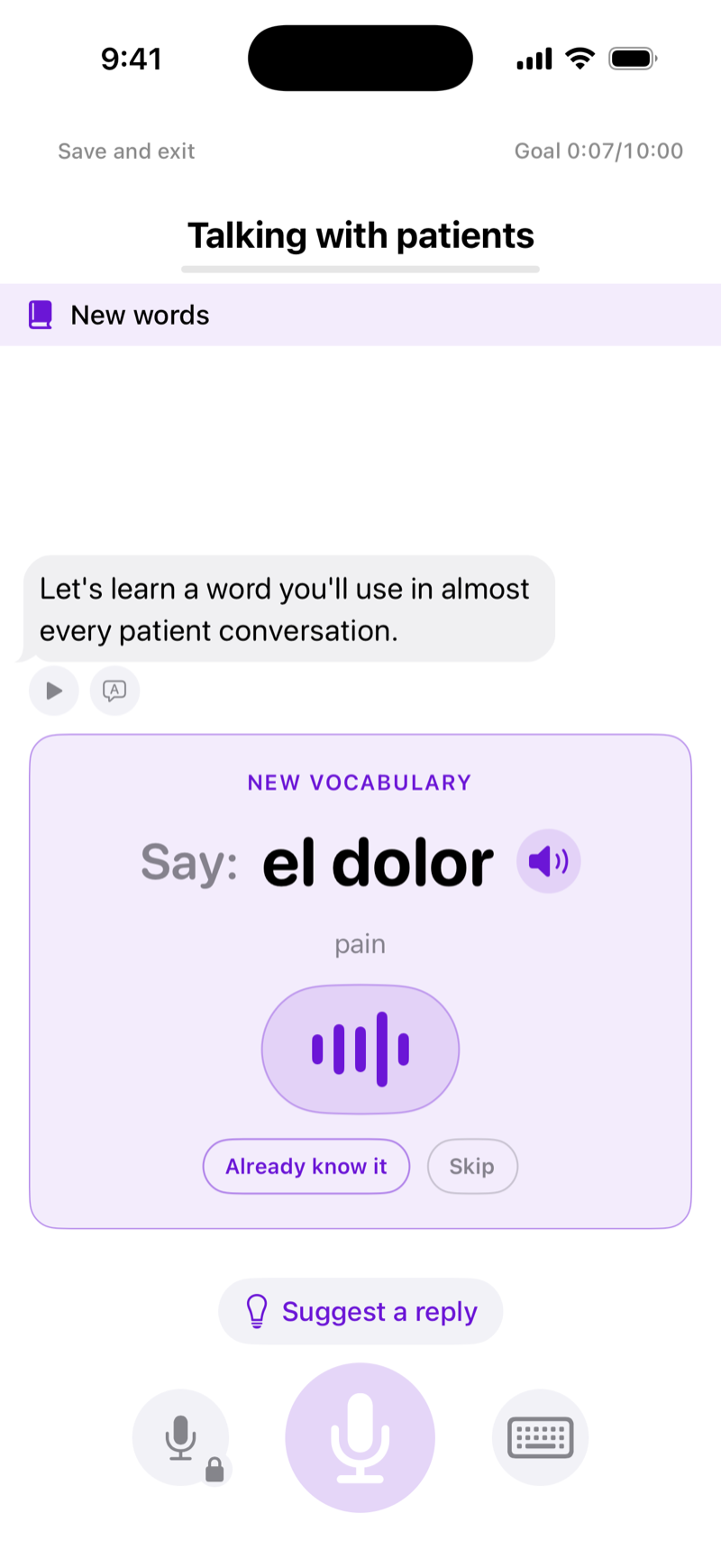
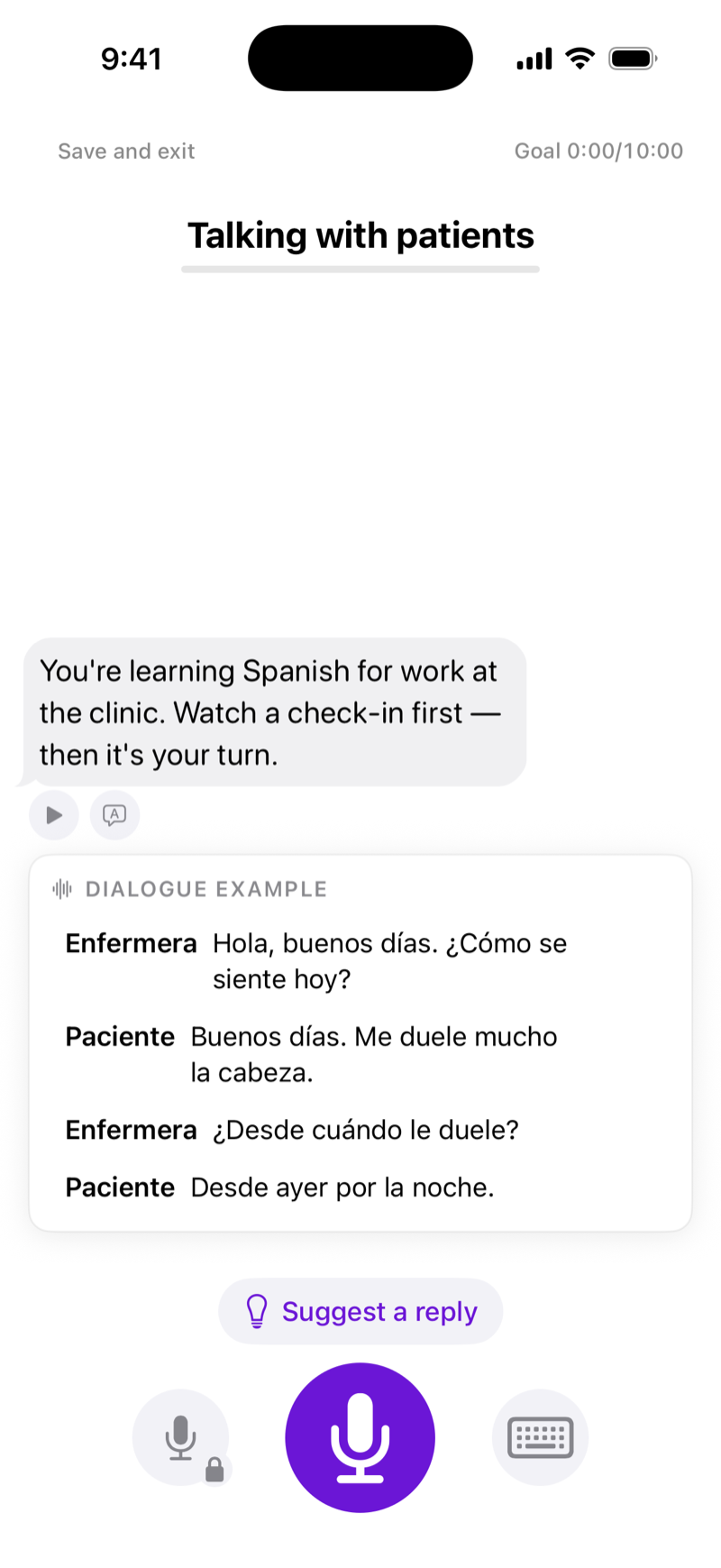
Where you can speak yourself, and where you shouldn't
You're the one in the room all shift. A patient presses the call light, they want to know when the pain medication is coming, and the interpreter line is a phone call and a hold away for a thirty-second exchange. So you point, you guess, and the small reassurance that would have settled them never happens. That routine bedside texture is most of a shift, and it's the part you can do yourself, if you can speak even a little.
What FluentPath is and isn't for
FluentPath helps you build the everyday Spanish you'll use at the bedside: assessment and vitals, pain and comfort checks, the medication pass, orientation and reassurance. It is not a substitute for a certified medical interpreter. For informed consent, patient teaching on a new diagnosis, changes to the care plan, or anything where mis-translation creates clinical or legal risk, use the language line.
Your patient came from somewhere and moves on to somewhere. The crew who brought them in works from Spanish for paramedics on scene, and the round you do together in the morning is covered on the Spanish for doctors page. And when you want the lines themselves, our phrase reference keeps a section of Spanish phrases for nurses ready to read out loud.
The head start you'll have after a few months
Roughly fifteen minutes a day for three months. Comfort-level Spanish for the bedside, not certified medical interpretation.
- Take vitals and walk a patient through an assessment in Spanish without freezing up.
- Run a pain and comfort check every round without waiting on the interpreter line.
- Explain a medication at the bedside: what it's for, how to take it, what to watch for.
- Recognize a few hundred of the most common symptom, medication, and comfort words by ear.
- Orient a patient to the room and the call light, and answer it with more than a gesture.
- Know clearly where the line is, and reach for the interpreter on consent and teaching every time.
Nobody becomes fluent in a few months of phone-app practice, including with us. The goal is comfort-level Spanish for the routine parts of a shift, so the interpreter line is reserved for the moments that actually need it and your patients aren't getting a thinner version of you the rest of the time.
Medical Spanish for your role
Same speaking-first app, tuned to the conversations you actually have. Practice the Spanish your role runs on.
Or start with the full medical Spanish app overview to see how FluentPath works across healthcare.
Common questions
Direct answers. If something's unclear, the contact form is in the footer.
Is FluentPath a substitute for a certified medical interpreter?
Do I need to already speak Spanish, or can I start as a beginner?
How much does it cost?
What languages does it support?
Will it cover my unit?
What devices does it work on?
How much practice per day?
Can my whole unit share one subscription?
Start with the conversation you need most.
You'll be speaking in your first lesson, whatever your level.
 Scan to install on iPhone
Free 7-day trial. No credit card required.5.0 on the App Store