 FluentPath
Medical Spanish for EMS and first responders
Spanish for EMTs and paramedics: run the call from scene to handoff.
Real prehospital conversations with an AI tutor, every day: the chief complaint, the red-flag questions, the reassurance. It meets you at whatever level your Spanish is now.

Free 7-day trial. No credit card required.5.0 on the App Store
See how it worksWhat FluentPath does differently
For EMS crews and first responders serious about actually using the language: speaking-first practice, every day, focused on the calls you really run, from beginner to advanced.
Speaking from lesson one
Hold the microphone and talk. The AI tutor talks back, corrects, and keeps you in the conversation when you stall.
Conversations shaped like a call
Practice the flow you run on scene: the chief complaint, OPQRST and SAMPLE, the red-flag questions, and the reassurance that keeps a patient still in the back of the rig.
A tutor with patience you can't burn through
Stumble through the same question twenty times with nobody's vitals dropping. Won't switch to English on you. Tracks what you know and pulls you forward.
Spaced repetition that actually retains
Symptom, history, and medication vocabulary you've used in conversation comes back at intervals tuned to memory science, so the words are there at 3am when you need them.
Example practice scenarios
Scene size-up and chief complaint
What happened, where does it hurt, when did it start, show me. Getting the story the moment you walk in.
Pain, mechanism, and red flags
Rate your pain zero to ten, does it hurt to breathe, did you hit your head, can you move your fingers. The focused assessment, out loud.
History, meds, and allergies
Do you take any medicine, any allergies, do you have diabetes or heart problems, are you pregnant. SAMPLE without a bystander translating.
Reassurance in the back of the rig
We're taking you to the hospital, stay still for me, I'm putting this on your arm, breathe slow. Keeping a frightened patient calm and cooperative.
Or describe the calls you want to rehearse: urban 911, rural, interfacility, BLS or ALS, the patient population you run most, and the app builds it.
New to this? Start with our list of Spanish phrases for EMTs and paramedics.
How it builds
Not a script. A language.
Three moments from the same first year. Nothing here was memorised, and no two conversations were the same.
Week one
First contact
Tutor Patient
…
You EMT
¿Me escucha? Soy paramédico.
Can you hear me? I'm a paramedic.
Three months later
Getting a history fast
Tutor Patient
Me duele el pecho.
You EMT
¿Desde cuándo le duele? ¿Toma alguna medicina?
How long has it hurt? Do you take any medication?
A year later
A family member panicking
Tutor Bystander
¡Haga algo, por favor!
You EMT
Estamos con él. Necesito que me diga qué pasó.
We're with him. I need you to tell me what happened.
Practice a scene like this
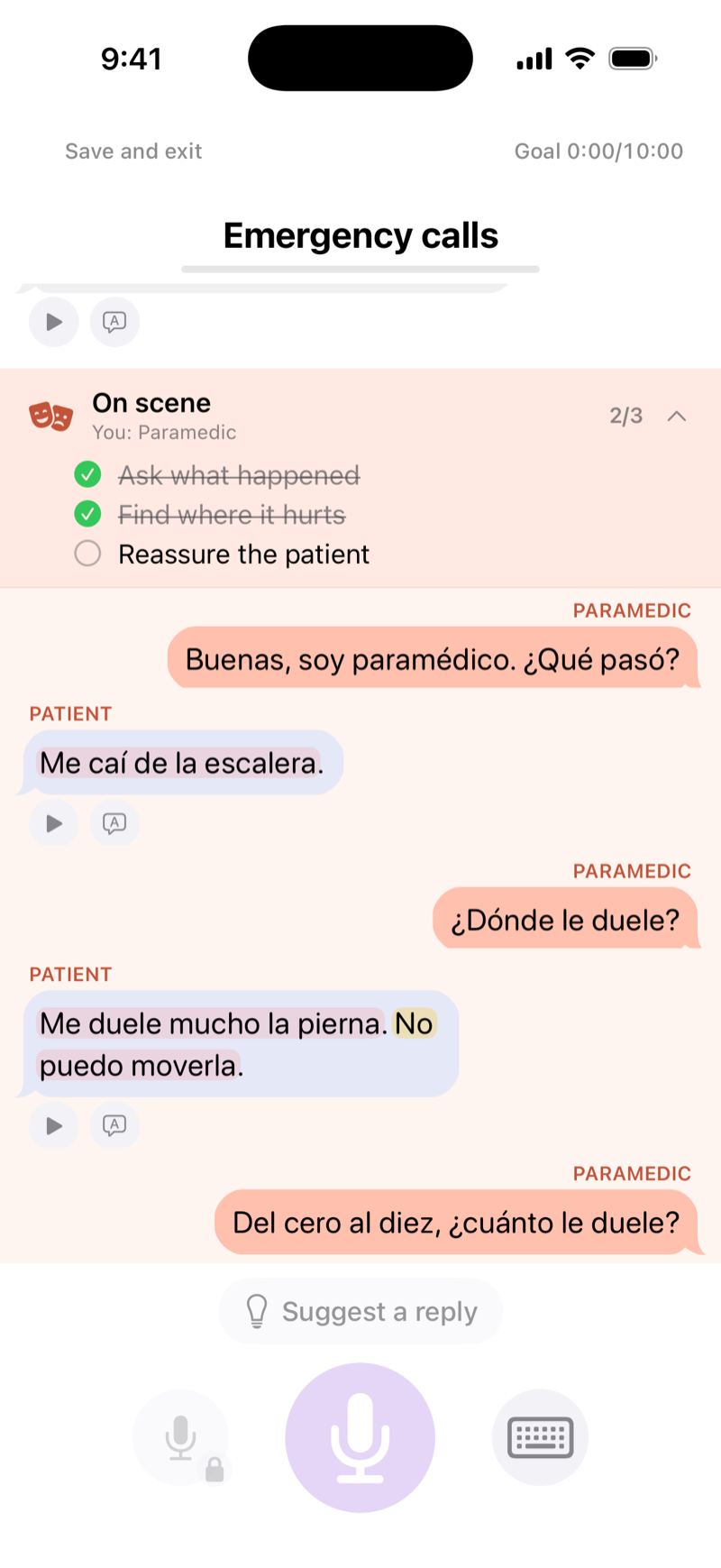
From a beginner-level roleplay. You speak your lines out loud; the AI answers as your patient.
You
Buenas, soy paramédico. ¿Qué pasó?
Hi, I'm a paramedic. What happened?
Patient
Me caí de la escalera.
I fell off the ladder.
You
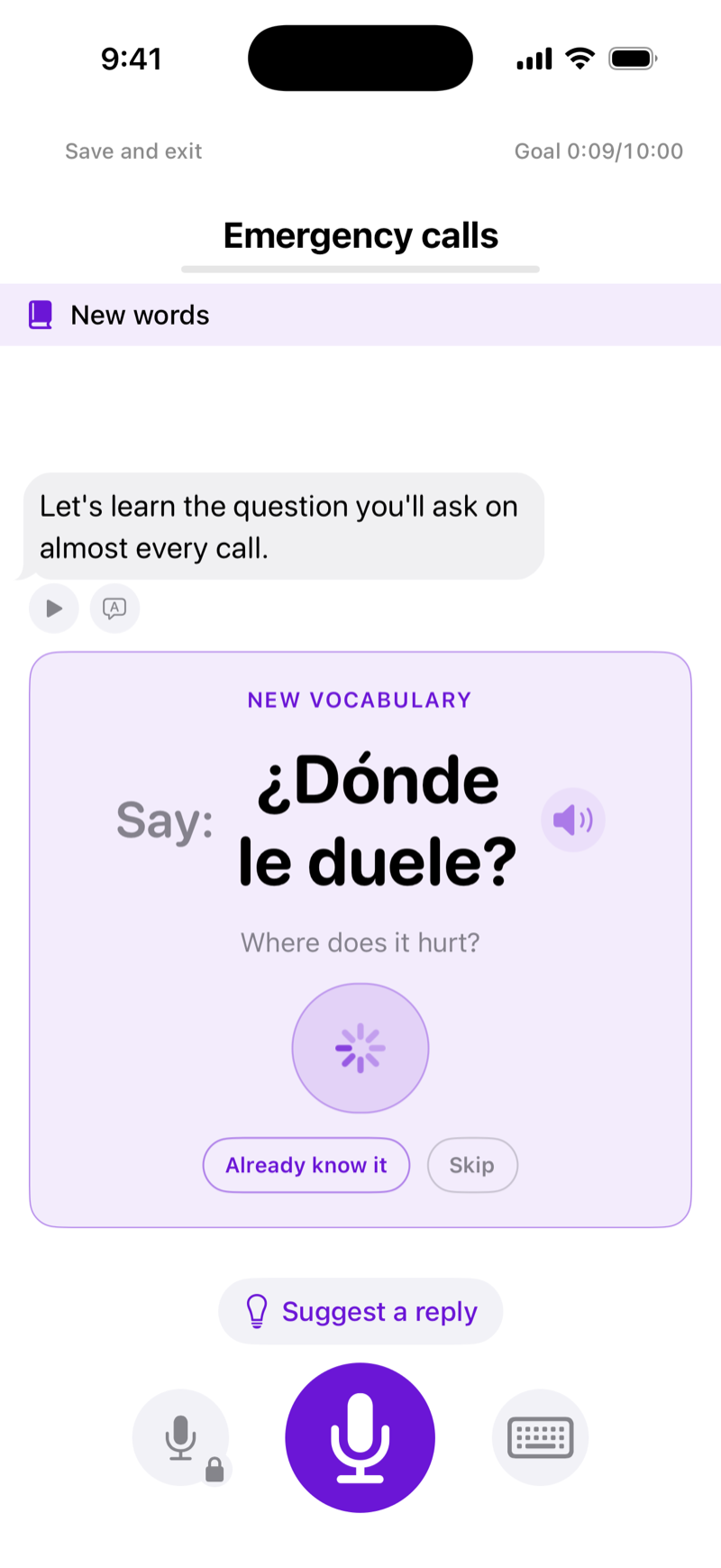
¿Dónde le duele?
Where does it hurt?
Patient
Me duele mucho la pierna.
My leg hurts a lot.
You
Del cero al diez, ¿cuánto le duele?
Zero to ten, how bad is the pain?
Patient
Ocho. No puedo mover la pierna.
Eight. I can't move my leg.
What it looks like
Real screens from the app.
Spanish for paramedics in the field, where there's no interpreter line
You show up to someone's worst moment and the first thing you need is the story: what happened, how long ago, are you on blood thinners. In the emergency department there's a language line for that. On scene, at 2am, in the back of a moving rig, there's you, a frightened patient, and maybe a relative translating through their own panic. The prehospital piece is exactly the part you can do yourself with even a little Spanish. You don't need to be a certified interpreter to ask where it hurts and mean it.
What FluentPath is and isn't for
FluentPath helps you build the everyday Spanish you'll use on a call: the chief complaint, OPQRST and SAMPLE, the red-flag questions, and the reassurance that keeps a patient calm from scene to handoff. It is not a substitute for a certified medical interpreter. For a formal refusal of care, consent for a procedure, or any exchange where mis-translation changes the treatment or the legal record, use certified interpretation and your service's protocols.
Your patient's story doesn't end at your handoff. The floor that takes them picks it up in the Spanish for nurses app, and the history you started gets repeated in the exam room, which is what the Spanish for doctors page covers.
The head start you'll have after a few months
Roughly fifteen minutes a day for three months. Comfort-level Spanish for the prehospital call, not certified medical interpretation.
- Get a chief complaint and a basic history on scene without waiting for a bystander to translate.
- Run OPQRST and SAMPLE on a Spanish-speaking patient and actually understand the answers.
- Ask the red-flag questions (chest pain, head injury, blood thinners, pregnancy, allergies) reliably, every call.
- Calm and instruct a scared patient in the back of the rig so they stay still and let you work.
- Recognize a few hundred of the most common symptom, history, and medication words by ear, under pressure.
- Know clearly where the line is, and reach for certified interpretation on refusals and consent every time.
Nobody becomes fluent in a few months of phone-app practice, including with us. The goal is comfort-level Spanish for the prehospital part of the call, so the scared patient in front of you gets a provider who can ask where it hurts and tell them what's happening.
Medical Spanish for your role
Same speaking-first app, tuned to the conversations you actually have. Practice the Spanish your role runs on.
Or start with the full medical Spanish app overview to see how FluentPath works across healthcare.
Common questions
Direct answers. If something's unclear, the contact form is in the footer.
Is FluentPath a substitute for a certified medical interpreter?
Do I need to already speak Spanish, or can I start as a beginner?
Is this Spanish for paramedics and other first responders too, or just EMTs?
How do you say EMT in Spanish?
How much does it cost?
What languages does it support?
Will it cover my service and call types?
What devices does it work on?
How much practice per day?
Can my whole service share one subscription?
Start with the conversation you need most.
You'll be speaking in your first lesson, whatever your level.
 Scan to install on iPhone
Free 7-day trial. No credit card required.5.0 on the App Store